Virtual Entities and the Construction of Narrative Identity
The creation of virtual entities has become a way of narrating identity through distance. These constructed presences move within social platforms as coherent characters, each with a defined tone, rhythm, and visual language. They embody aspects of a brand and of the designer behind it, translating abstract values into recognizable personalities. What begins as a communicative strategy gradually becomes a parallel narrative space where identity is curated, shaped, and projected.
Yet this projection unfolds within systems that privilege speed, clarity, and aesthetic perfection. The constant exposure to polished images risks altering the perception of everyday life, making the ordinary appear insufficient when compared to the curated surface of the feed. As representation becomes continuous, pauses diminish. Reflection competes with immediacy. The rhythm of digital narration compresses time and narrows attention.
In this context, virtual entities can either reinforce the logic of perfection or question it. They can replicate the smoothness of idealized identity, or they can reveal their own constructed nature, reintroducing fragility and slowness into digital communication. Between projection and presence, between acceleration and pause, lies the essential tension of contemporary identity.
From Natural Algorithms to Digital Processes
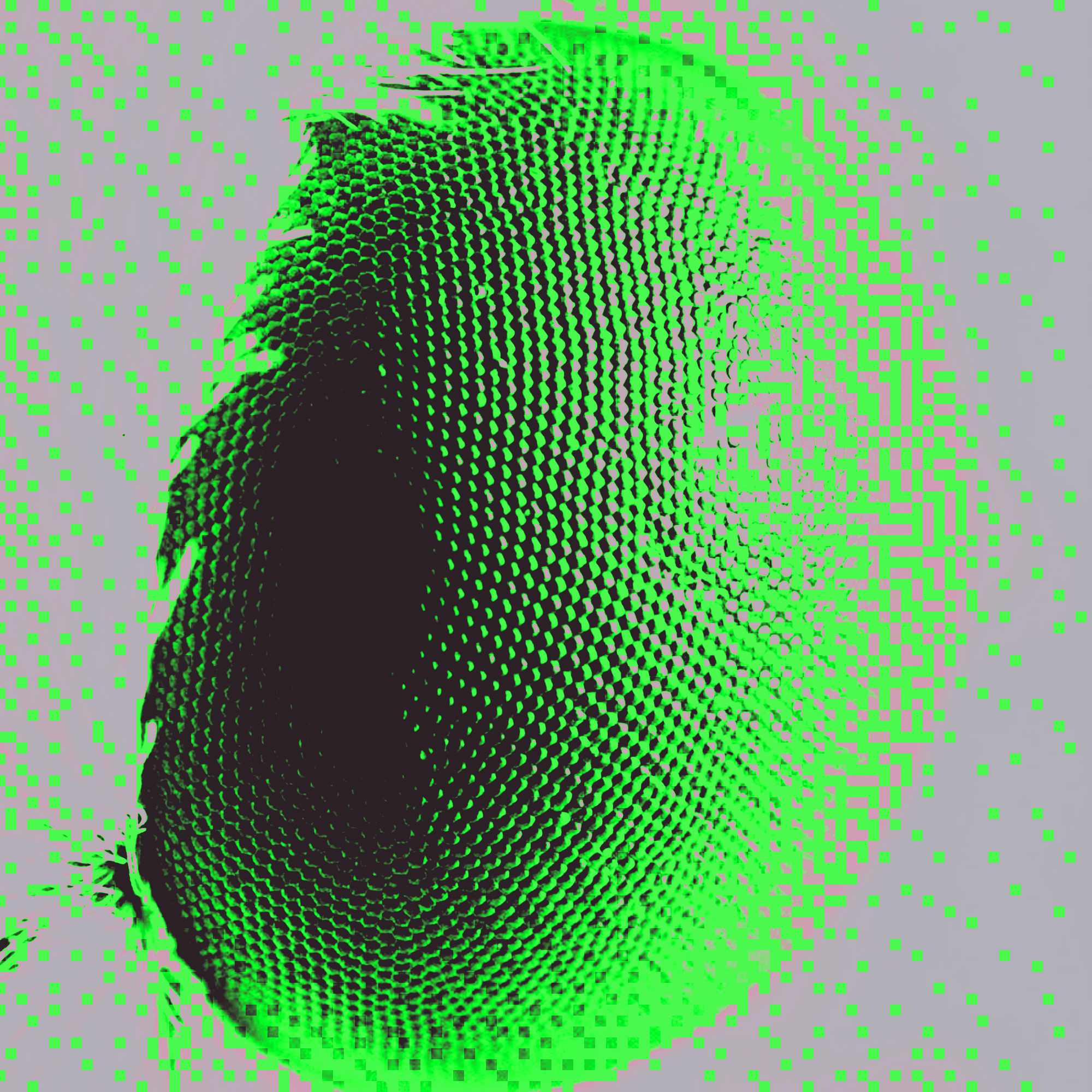
This fascicle emerges from an apparent fracture: the tension between continuity and discreteness, between what appears fluid and what is constructed from minimal units. The texts that follow move along this threshold, interrogating not only the technologies of digital imagery but the very conditions through which reality takes shape before our eyes.
Pixelation and dithering are not treated here as mere visual effects or technical byproducts of hardware limitation. They are approached instead as interpretive instruments. They act as revealing traces of a deeper process, one shared by both code and nature: the necessity of translating complexity through finite structures.
The first text focuses on the mathematical and computational grammar of digital images. The pixel emerges as a unit of measurement and compromise, while dithering asserts itself as a strategy for redistributing error, transforming imprecision into perceived continuity. The image is no longer understood as a copy of the real, but as the outcome of a negotiation between constraints, algorithms, and the physiology of vision.
The second text expands this reflection beyond the technological domain. The same logics of discretization, variation, and recomposition are traced within natural systems: in biological surfaces, in evolutionary processes, and in the structure of vision itself. What the digital renders explicit, nature has long practiced silently.
Within this dialogue, the boundary between the artificial and the organic thins to the point of near dissolution. The dithered image and the texture of a natural surface share a common tension: the production of coherence from imperfection, of order from noise.
This preface does not aim to provide a definitive interpretive key, but rather to invite a shift in perspective. The texts that follow are not meant to be read solely as technical explanations nor as abstract theoretical exercises, but as a passage. A movement that begins in code, passes through science, brushes philosophy, and returns to matter.
Because, ultimately, the digital is not an elsewhere. It is one of the forms through which the world continues, today, to make itself visible.
At the Threshold of Light
To wear a nature reshaped through the digital is to inhabit a threshold. Not a rigid boundary, but a zone of passage where matter encounters code and the earth opens itself to abstraction. In this space, the digital is not elsewhere. It becomes a language that gains meaning only when it deepens our bond with the living world. Without roots, the image remains surface. Without image, matter risks becoming mute. Meaning emerges in their encounter.
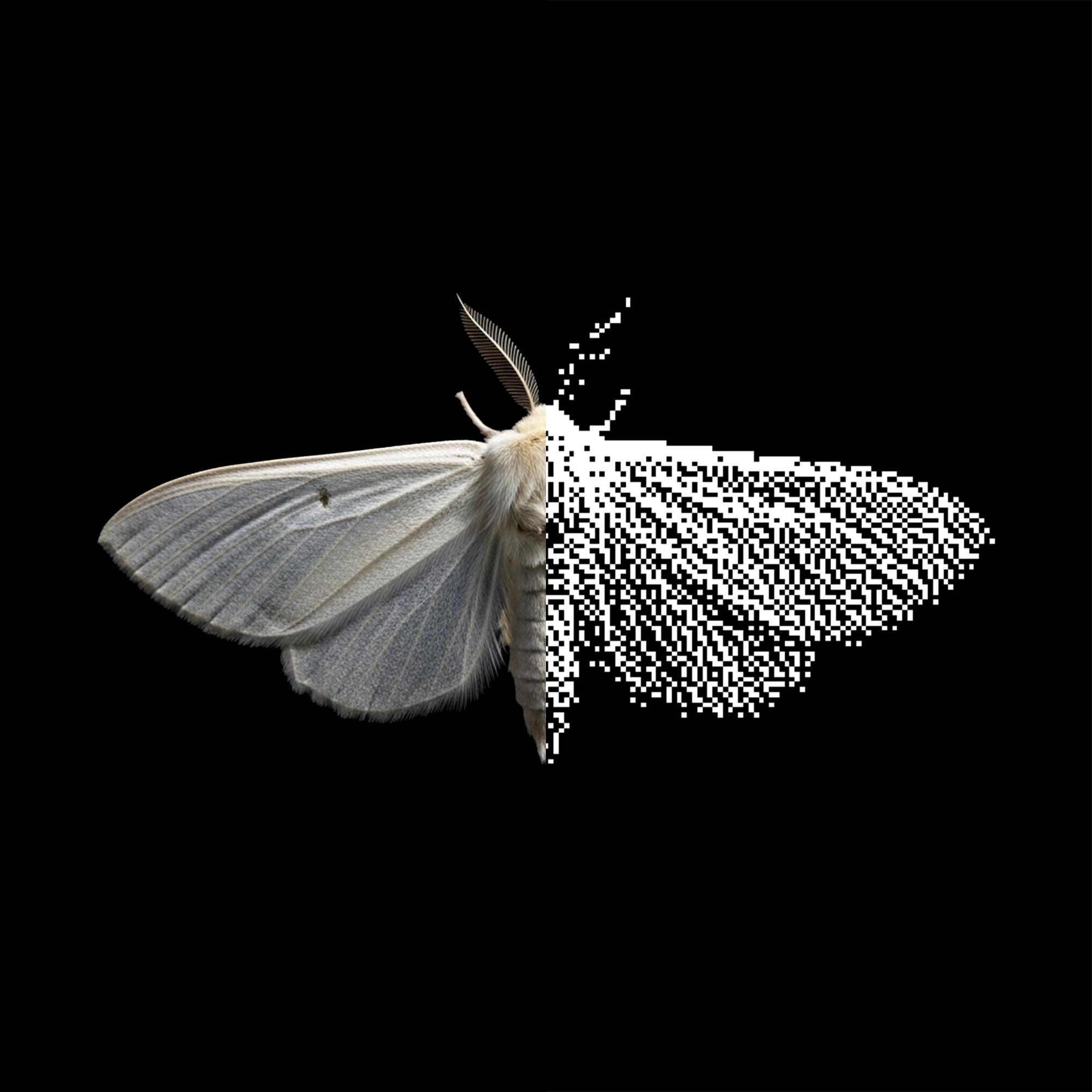
The moth belongs to this logic of thresholds. Biologically, it is a nocturnal lepidopteran, equipped with compound eyes capable of detecting extremely subtle variations of light, more attuned to intensity than to form. Its vision does not construct stable images, but fields of orientation. It sees in order to move, not to possess. Visual input is integrated with olfactory and spatial cues in a distributed perception that dissolves the separation between body and environment. Night, for the moth, is not the absence of vision, but a different regime of seeing.
Its attraction to light originates in a natural principle of orientation. Many moths use distant light sources, such as the moon, to maintain a stable trajectory. Artificial lights disrupt this relationship, bending the reference point and drawing the insect into a looping, hypnotic movement that is often fatal. Science explains this behavior with precision, yet its resonance exceeds biology. The moth does not seek light to understand it, but because it recognizes it as direction. Its flight is neither fully conscious nor blindly mechanical. It is a response.
Within this gesture, a broader reflection on vision unfolds. Seeing is not a neutral act. It is not a window opening onto a world already formed. Maurice Merleau Ponty writes that vision is not thought observing the world from a distance, but the body inhabiting the visible. The gaze is an embodied interface, a site of contact where the world passes through us as much as we pass through it. Every act of perception is already a form of involvement, a positioning within reality. The moth, with its way of seeing without dominating, makes this condition visible. It does not observe the world from outside. It belongs to it.
The moth’s life cycle reinforces this continuity. Caterpillar, chrysalis, winged form are not separate identities, but temporary configurations of the same matter in transformation. During metamorphosis, the body dissolves and reorganizes itself, redistributing cells and functions into a radically new form. Biology describes this process in detail, yet its meaning exceeds description. Transformation is not the loss of identity, but its displacement. Henri Bergson spoke of life as duration, a continuous flow in which nothing ever remains entirely identical to itself. The moth embodies this idea. It does not become something else. It becomes again.
When nature is translated into image and impressed onto a wearable surface, this flow does not stop. It shifts medium. Printing does not freeze the living, it reformulates it. Grids, pixels, and vectors become the language through which leaves, stone, tides, and insects continue to exist as presences. Not as decoration, but as traces. The body that wears them is not a passive support, but the site where image and matter coincide. Skin registers weight, the eye reads the sign, thought holds together what appears divided.
The theme that runs through this process is not declared, but operative. It is the gaze as a filter between the tangible and the intangible. A gaze that does not separate, but translates. Perception becomes an act of continuous mediation, a passage between what can be touched and what remains invisible yet active. In this sense, the digital image is not an illusion, but another threshold of the real. It does not replace the world. It stratifies it.
This becomes evident in the gesture that activates the work. Framing a printed object with a smartphone is not a secondary act, but a decisive passage. The image reveals itself only on the screen, as if emerging from a latent layer of matter. The device does not erase the physical presence of the object, it renders it legible in another register. The hand holding the phone anchors the body to the world, while the screen opens a window onto what is not immediately visible. The digital appears only through a concrete action. Code requires gesture.
Here the moth returns as a silent but central figure. A creature that lives in shadow, yet orients its flight toward light, it suggests that knowledge does not always pass through clarity. Sometimes it passes through intuition, exposure, and risk. Søren Kierkegaard wrote that to dare is to lose one’s footing momentarily, not to dare is to lose oneself. The moth’s flight embodies this tension. It offers no promise of salvation, only movement.
Between matter and image, body and vision, nature and the digital, there are no separate worlds. There is a weave. To remain grounded is to accept it without closing it into a system. With roots in the soil and the gaze open toward what cannot be fully grasped, yet continues to call.